
For the past few months I have been building a tool around the Śiva Svarodaya, a Sanskrit manual on the breath. You tell it the date and time, it tells you which nostril the text expects to be open, and you record which one actually is.
It was while building the calculation that I ran into a problem. The single verse the whole calculation rests on is the one verse in that section the evidence contradicts. I could have quietly left it out. Instead I want to write about it, because the way that verse fails is more interesting than anything it would have told me if it worked.
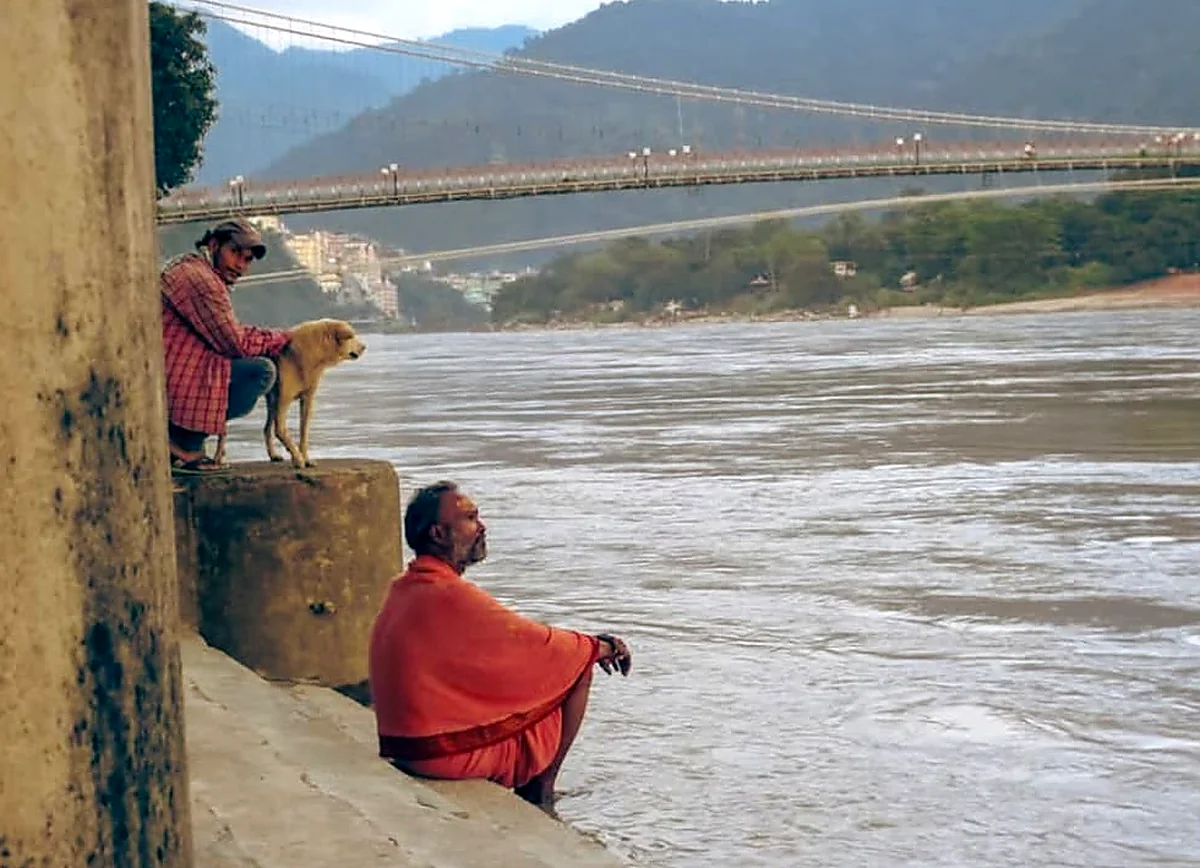
What the text actually is
The Śiva Svarodaya is a treatise of uncertain date, carried in the Nātha and Śaiva lineages, written as a dialogue in which Śiva instructs Pārvatī. Manuscripts run to roughly 390 to 400 verses. The recension I have been working from holds 313 of them.
What surprised me is how little theology is in it. The bulk of the text is procedural. How to tell which nostril is dominant. How long dominance lasts. What changes when it switches. Which actions go well under which condition, and how to force a switch deliberately.
Strip away the cosmological vocabulary and what is left is a manual of self-measurement. I do not think there is a more detailed one from before the twentieth century.
That is also what makes it worth checking rather than admiring.
What holds up: there really is a rhythm
The text’s foundational claim is that nasal airflow is not symmetrical, that one side dominates, and that dominance alternates on a cycle of a few hours.
This is true, and it was documented in the West by the rhinologist Richard Kayser in 1895. The mechanism is vascular rather than muscular: the turbinates inside the nose contain erectile venous tissue under autonomic control. Sympathetic outflow drains that tissue and opens the airway; parasympathetic dominance engorges it and closes it.
So the relative openness of your two nostrils is a readout of autonomic state that you can check in about five seconds, with nothing but attention. The entire text is an elaboration of that one fact.
But the modern measurements are messier than the tradition suggests — with an important caveat about who was measured, which I come to next. Kahana-Zweig and colleagues at the Weizmann Institute logged airflow in both nostrils of 33 healthy adults for roughly 24 hours each, and published the result in PLOS ONE in 2016.
The average dominance period was 2.15 hours, which sits neatly inside the one-to-three-hour window the text describes. For a document composed without a clock, that is a genuinely impressive piece of observation.
The honest caveat is the rest of the finding. The classical picture — two nostrils trading places on one shared, regular rhythm — fitted only a minority of the sample. Congestion sometimes rose on both sides at once. The authors concluded that each nostril may oscillate somewhat independently.
The objection that the text deserves
There is an obvious reply to all that, and I think it is a fair one.
Those 33 people were ordinary adults. The Śiva Svarodaya is not describing ordinary adults. It describes a practitioner — someone whose breath has been worked on for years. And the mechanism is not far-fetched. The nasal cycle is driven by the autonomic nervous system, and sustained slow breathing demonstrably shifts autonomic balance. It is entirely coherent that a trained practitioner would show the clean, reciprocal rhythm that an untrained sample does not.
That is a real prediction, and it is the most interesting thing in this article: if the tradition is right, experienced practitioners should show a more regular nasal cycle than matched non-practitioners.
Nobody has tested it. I went looking. The studies that recruit experienced practitioners measure what happens during a breathing practice — EEG, heart rate, performance — not whether the spontaneous cycle is more regular across an ordinary day. The 24-hour logging study used untrained volunteers. The comparison that would settle the question, a day of recording in trained practitioners against matched controls, does not appear to have been run.
So the position is not that the text is wrong about the rhythm. It is that the strongest version of the text’s claim has never been put to the test. That is a better place for it than I expected to be able to report, and it is a standing invitation, because this is a cheap study: two nasal cannulae, a day, and two groups.
One discipline is worth keeping if anyone does run it. Say beforehand what result would count against the claim. “They had not mastered it” can absorb any disconfirming data at all, and a claim defended that way quietly stops being a claim about the body and becomes a claim about who counts as a master. Naming the prediction in advance — this many practitioners, this many hours, this much more regular — is what keeps it a claim about noses.
So: the rhythm is real. Whether it is as regular as the text implies is, for the trained practitioner, still an open question.
What holds up: the nose is wired into the brain
This is the finding that made me take the text seriously in the first place.
Until recently, breathing was treated in most of neuroscience as noise — something to be filtered out of a brain scan. Zelano and colleagues at Northwestern changed that in 2016, recording directly from electrodes implanted in patients with epilepsy and publishing in the Journal of Neuroscience.
They found that oscillations in the piriform cortex, the amygdala and the hippocampus lock onto the rhythm of the breath. Crucially, this depended on breathing through the nose. When the patients breathed through the mouth, the effect weakened substantially. Performance followed: recognising fear in a face, and retrieving a memory, both varied with where in the breath cycle the task fell — and only during nasal breathing.
The mechanism is mechanical. Sensory neurons in the nasal lining respond to airflow itself, not only to smells, and the olfactory bulb projects straight into the limbic system without passing through the thalamus first. Nasal breathing delivers a rhythmic pulse directly into the emotional and memory machinery of the brain, once per breath, all day.
That is why a text obsessed with the nose is not as strange as it sounds.
The bridge that does not hold
Now the part where most popular writing about swara yoga goes wrong, and where I had to correct my own notes while building the tool.
The text pairs left-nostril flow (iḍā, lunar) with cooling, receptivity and stillness, and right-nostril flow (piṅgalā, solar) with heat, exertion and movement. In 1983, Werntz, Bickford, Bloom and Shannahoff-Khalsa reported in Human Neurobiology that the nasal cycle was accompanied by alternating EEG dominance in the opposite hemisphere — right nostril open, left hemisphere more active, and the reverse.
It was an electrifying result. It appeared to hand the tradition a modern mechanism.
It has not held up.
Telles and colleagues tested it directly in BMC Research Notes in 2017, with thirteen practitioners who practised breathing regularly at a yoga centre in north India. They expected hemispheric symmetry to change. It did not. They said so.
That detail matters, and it is why I treat this claim differently from the one above. The objection that an effect will only appear in trained breathers is a fair challenge to the nasal-cycle data, where the volunteers were untrained. Here it has already been met: these were trained breathers, and the effect still did not appear.
Frohlich, Frohlich and Sklerov ran the best-powered test I could find, in PLOS ONE in 2025: nineteen people, 128-channel EEG, left-, right- and alternate-nostril breathing in random order. There was no lateralisation of power. There was a lateralised connectivity effect, but it ran ipsilaterally — stronger on the same side as the nostril in use, which is the opposite of what the 1983 result described. Heart rate, heart-rate variability and working memory did not differ between conditions at all.
I want to be fair to both studies: thirteen and nineteen people are small numbers, and the 2025 authors are careful to say their own result needs replicating. This is not a decisive refutation. It is the absence of the support the claim is usually said to have.
And there is a deeper problem underneath. The framework the finding gets pressed into — analytic left brain, creative right brain — is itself largely wrong. Nielsen and colleagues looked at resting-state brain connectivity in 1,011 people for PLOS ONE in 2013 and found no evidence that anyone is globally left- or right-brained. Lateralisation is real, but it is local to particular networks, not a personality setting for the whole head.
So even a clean nostril-to-hemisphere link would not deliver what people want from it.
The verse I wanted to work
Here is the one the tool depends on.
शुक्लपक्षे भवेद्वामा कृष्णपक्षे च दक्षिणा। जानीयात्प्रतिपत्पूर्वं योगी तद्यतमानसः॥६५॥
śuklapakṣe bhaved vāmā kṛṣṇapakṣe ca dakṣiṇā | jānīyāt pratipatpūrvaṃ yogī tadyatamānasaḥ ||65||
In the bright fortnight the left flows; in the dark fortnight, the right. The yogin of disciplined mind should know this from the first lunar day onward. — Verse 65
This is a chronobiological claim and it can be assessed as one. It predicts which nostril will be open at a reference time, from the lunar day. It is the only rule in this part of the text that derives a nostril from a date, which is precisely why a calculator needs it.
The evidence does not support it. The nasal cycle’s documented determinants are posture, pressure on one side of the body, exercise, temperature, allergic status, hormonal state and sleep stage — and every one of those is more powerful than any proposed lunar influence. I could not find a controlled study demonstrating the association the verse asserts.
The wider literature on lunar effects is not encouraging either. Cordi and colleagues re-analysed sleep recordings from 1,265 volunteers across 2,097 nights for Current Biology in 2014 and found no reliable association between lunar phase and sleep. Their title names the likely reason earlier studies disagreed: the file drawer problem. Null results do not get published, so the positive ones look more numerous than they are.
I have built the lunar calculation into the tool anyway, with the contradiction stated on the page, because a tool that shows you a prediction and then records what actually happened is more useful than one that quietly drops the prediction it cannot defend. But I want to be plain here: the expected-nostril figure it shows you rests on a verse I do not believe.
A claim about the airway, generated by the word “moon”
So why does this verse appear, stated so confidently, in a text that elsewhere observes carefully?
Because it is not doing the same kind of work as the other verses. It is not reporting an observation. It is importing a framework.
The chain runs like this. The left channel is called candra, lunar. The moon waxes through the bright fortnight. Therefore the left nostril should flow during the bright fortnight. Every step follows from the vocabulary. Not one of them requires anyone to have looked at a nose.
I think this is the most useful thing the Svarodaya has given me, and it has nothing to do with breathing.
When a model hands you a confident prediction, ask where the prediction came from. Did it come from watching the system? Or did it come from the internal logic of the model’s own vocabulary — from what its words already imply about each other?
Predictions of the second kind are extremely common. They feel identical from the inside. They are usually wrong.
Verse 65 is a clean specimen because the error is visible from outside its framework. I do not think in lunar and solar channels, so I can see the join. The harder question, and the one I keep returning to, is which of my own confident claims are the same shape — generated by a vocabulary I am too close to notice I am using.
What I am keeping
A fair amount, as it turns out.
The observation itself. Check which nostril is dominant. It takes five seconds, costs nothing, and you are reading a real autonomic signal.
The anchor, without the lunar reckoning. The text ties the check to a reference moment. That instinct is right even though its particular anchor is not. Self-tracking fails on remembering, not on design, so attach the check to something unavoidable — waking, your first meal, the end of the working day — rather than to a clock time.
The record, including the misses. This is the part people skip. Write down what you predicted and what happened, and keep the entries where you were wrong. A log of hits only is not evidence of anything.
Nasal breathing rather than mouth breathing. This is the claim here with the clearest mechanism behind it. Though note what Zelano’s work actually shows: that the brain’s rhythm follows nasal airflow, not that breathing through your nose will make you calmer or happier.
The open question, held open. Whether a trained practitioner’s cycle is more regular than an untrained one’s is untested, and worth testing. I would rather say that than either assume it or dismiss it.
What I am not keeping is the claim that any of this balances your hemispheres. On present evidence it does not, the one modern well-instrumented test points the other way, and in the study that did recruit regular practitioners the effect still failed to appear.
What the tradition is actually offering
I want to be careful at this join, because it is where overclaiming usually happens.
The Śiva Svarodaya does not separate description from prescription, or physiology from omen. A verse recording what the breath does sits next to a verse promising what will happen if you act while it is doing it. To the text these are one kind of statement. They are not.
Hold them apart and something unusual survives: a self-administered, zero-cost method for reading your own autonomic state, refined over centuries by people with nothing to measure with but attention. Collapse them and you are left with astrology.
The text cannot tell me which nostril will be open tomorrow morning. It can tell me to go and look. That turns out to be the more valuable instruction, and it is the one I nearly lost while trying to make the other one work.