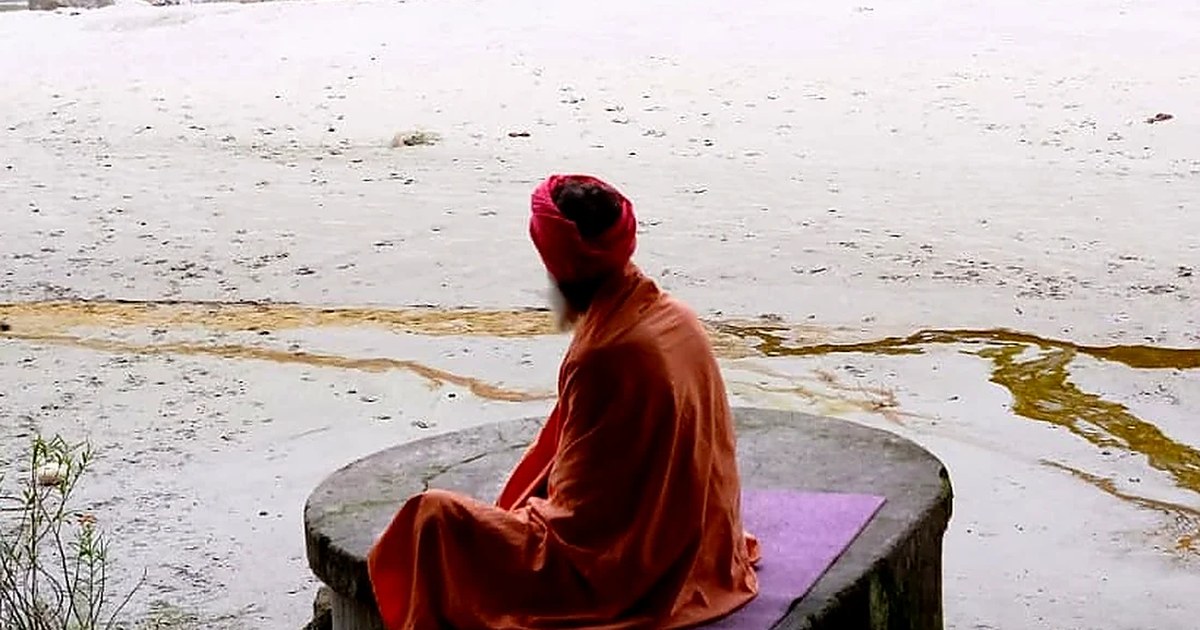
There is an argument in the non-dual Śaiva tradition that I keep coming back to, and it goes roughly like this.
You try to understand consciousness as though it were a lamp lit by the movement of matter. But who is it that knows both the lamp and the darkness? Before any thought arises, before any perception appears, there is that which knows — and the knower is not produced by what it knows.
It is a good argument. It is also, in its usual form, completely untestable, and I want to be plain about that from the start rather than pretend otherwise at the end.
In brief
The tradition is not claiming that brains are unreal or that neuroscience is wrong. It is making a claim about the direction of explanation: that consciousness is what is fundamental, and the brain is one of the forms it takes, rather than the machine that manufactures it.
Neuroscience has not refuted that. But neither does the state of neuroscience support it — and the second half of that sentence is the one I see dropped most often, including by people I agree with.
The argument, as the tradition makes it
Four moves, compressed. I have written about the philosophy at more length in Recognition as Liberation.
Consciousness, cit, is held to be self-luminous — prakāśa. It needs no second light to reveal it, because it is that by which everything else is revealed. You never observe your own awareness the way you observe a cup; you are the observing.
To that is added vimarśa: awareness not only shines but knows that it shines. On this account, were awareness incapable of recognising itself, nothing could become a lived experience at all. It would be processing with nobody home.
What is called an individual mind is, on this account, consciousness accepting limitation. Māyā here does not mean illusion in the sense of a trick. It means contraction — the infinite experiencing itself as finite. The universe is not a thing standing outside consciousness; it is consciousness in its own creative movement, which the tradition calls spanda, a pulsation.
And so liberation is not an acquisition. Pratyabhijñā means recognition: the discovery that the witness of all experience was never bound in the first place. Contemplative practice does not manufacture awareness. On this view it thins the veils over something already present.
Whatever else you think of it, notice that this is a coherent position rather than a vague one. It says something specific, and it says it in a way that has consequences.
Do not mistake the lute for the music
The tradition’s objection to the neuroscientific account is not that the measurements are wrong. It is that they describe an instrument.
Researchers have mapped the body and the brain with real precision. They have found that when large numbers of neural processes come into particular relations, experience becomes reportable, clear, available to thought. Those are good observations and I do not dispute them.
The claim is that they describe the changing reflections on a mirror rather than the mirror. The two sides are asking different questions. Neuroscience asks how the brain produces consciousness. The Trika asks how consciousness appears as the brain. And here is the uncomfortable part: the same correlational data is compatible with both.
This is not a mystical point and it is not original to me. It is roughly what David Chalmers named the hard problem in the Journal of Consciousness Studies in 1995: you can explain every function — discrimination, integration, reportability, the control of behaviour — and still have asked nothing about why any of it is accompanied by experience. The functional story can be completed without touching the question.
What the brain studies actually show
Here I have to be careful, because the version of this argument I was handed overstates its own evidence, and I would rather correct it than repeat it.
The claim usually made is that during deep contemplative states, neuroscientists see networks becoming more coherent, habitual self-referential patterns falling silent, and attention acquiring extraordinary stability. The honest version is thinner.
The best-known study is Brewer and colleagues, in PNAS in 2011. Experienced meditators showed less activation than controls in the posterior cingulate cortex, a hub of the default mode network, across three different meditation styles, and stronger coupling between that hub and regions associated with cognitive control. That is a real and interesting result. It is also twelve meditators against twelve controls. The authors say themselves that the sample is small, that the whole-brain results need replication, and that the design cannot show that meditation produced the difference rather than that people who differ take up meditation.
On attention, the picture is messier still. Ehmann and colleagues reviewed the long-term meditator literature in NeuroImage in 2025 and found improvements reported across attentional domains — but mixed, with alertness and response inhibition especially inconsistent, most designs cross-sectional, samples sometimes as small as six or eight, self-selection into retreats uncontrolled, and the whole review resting on eighteen studies. Their own word for the findings is “preliminary”.
So “extraordinary stability of attention” is not something the literature has established. Something is probably there. Its size and its cause are both open.
The state of the science is worse than you think
If you want to argue that neuroscience has not explained consciousness, you do not need philosophy. You can simply read what the field says about itself.
In 2025 the Cogitate Consortium published the result of a seven-year adversarial collaboration in Nature: 256 participants across seven laboratories, using fMRI, MEG and intracranial EEG, with every hypothesis and analysis preregistered and all parties agreeing in advance to accept the outcome. It was designed to put the two leading theories of consciousness — integrated information theory and global neuronal workspace theory — against each other properly.
Neither theory came through. The posterior synchronisation that integrated information theory predicted was not found. Global workspace theory did better in places and failed in others, with the predicted ignition at the end of a conscious episode not confirmed.
There is a second finding I find even more striking. Yaron, Melloni, Pitts and Mudrik built a database of 412 consciousness experiments for Nature Human Behaviour in 2022, and reported that whether a study came out supporting a given theory could be predicted from its methodological choices alone, irrespective of the findings. Most studies, they note, interpreted results after the fact rather than testing a theory’s critical predictions in advance.
That is a field discovering that its experiments substantially return whatever was put into them. Readers of what I wrote last week will recognise the shape of the problem.
Why none of that helps the tradition
Now the part I think matters most, and the part the version I was given does not say.
None of the above is evidence for the Śaiva position. Not a little bit of evidence. None.
“Neuroscience cannot currently explain consciousness” and “consciousness is therefore fundamental” are separated by a gap that no amount of difficulty on the first side will close. A failing theory does not transfer its credibility to whichever rival is standing nearby. If it did, every unsolved problem in science would be an argument for everybody’s favourite metaphysics at once, which is obviously absurd.
And the Trika claim has a harder problem than lack of support: in its usual formulation it does not forbid any observation. Whatever neuroscience finds — a tidy neural correlate, a messy one, none at all — can be described as consciousness appearing as the brain. A claim compatible with every possible result is not being confirmed by the results it is compatible with.
I do not say this to dismiss it. Some genuinely important claims are not empirical, and treating them as failed science is its own category error. But it does mean the tradition cannot have it both ways. It cannot be above testing when the evidence is awkward and vindicated by evidence when a study looks friendly.
What I keep
I keep the question, which I think is a real one and is not answered by anybody at present.
I keep the observation that self-awareness is strange in a way the functional accounts do not dissolve. The fact that the two leading theories both stumbled on a careful, preregistered test is not proof of anything metaphysical, but it is a reason not to accept confident popular claims that the matter is basically settled.
And I keep the discipline of separating the parts. The claim that consciousness is self-luminous is philosophy. The claim that experienced meditators show reduced posterior cingulate activation is a finding about twelve people, in need of replication. The claim that realisation stabilises attention extraordinarily is, as it stands, not established. Three different kinds of statement, and the quickest way to ruin all three is to let them lend each other credibility they have not earned.
What I will not do is use the difficulties of consciousness science as a back door for a conclusion I happen to like. If the Trika view is true, it is not true because neuroscience is having a hard decade.
Sources
- Chalmers D. Facing up to the problem of consciousness. Journal of Consciousness Studies (1995), 2(3):200–219.
- Brewer JA, Worhunsky PD, Gray JR, Tang YY, Weber J, Kober H. Meditation experience is associated with differences in default mode network activity and connectivity. PNAS (2011), 108(50):20254–20259. PNAS
- Ehmann S, Sezer I, Keller AS, Treves IN, Sacchet MD. Attention and meditative development: a review and synthesis of long-term meditators. NeuroImage (2025), 323:121602. doi.org
- Cogitate Consortium (Ferrante O and colleagues). Adversarial testing of global neuronal workspace and integrated information theories of consciousness. Nature (2025). nature.com
- Yaron I, Melloni L, Pitts M, Mudrik L. The ConTraSt database for analysing and comparing empirical studies of consciousness theories. Nature Human Behaviour (2022), 6:593–604. nature.com