
The Quiet Mind Lesson 5 of 6 · Breath
Your Breath Is a Door
Breathing is the one automatic rhythm you can also steer. Three studies show how it talks back to the brain, and the film ends with a guided breath you do along with it.
Unlock all the films with your email
You get all six films in The Quiet Mind, plus evidence-checked articles on meditation and breathing by email. No payment. Unsubscribe any time.
Your email is kept by Kit, the service that sends our newsletter. See the privacy page.
You're in. Check your inbox and click Kit's confirmation link, so the articles reach you too.
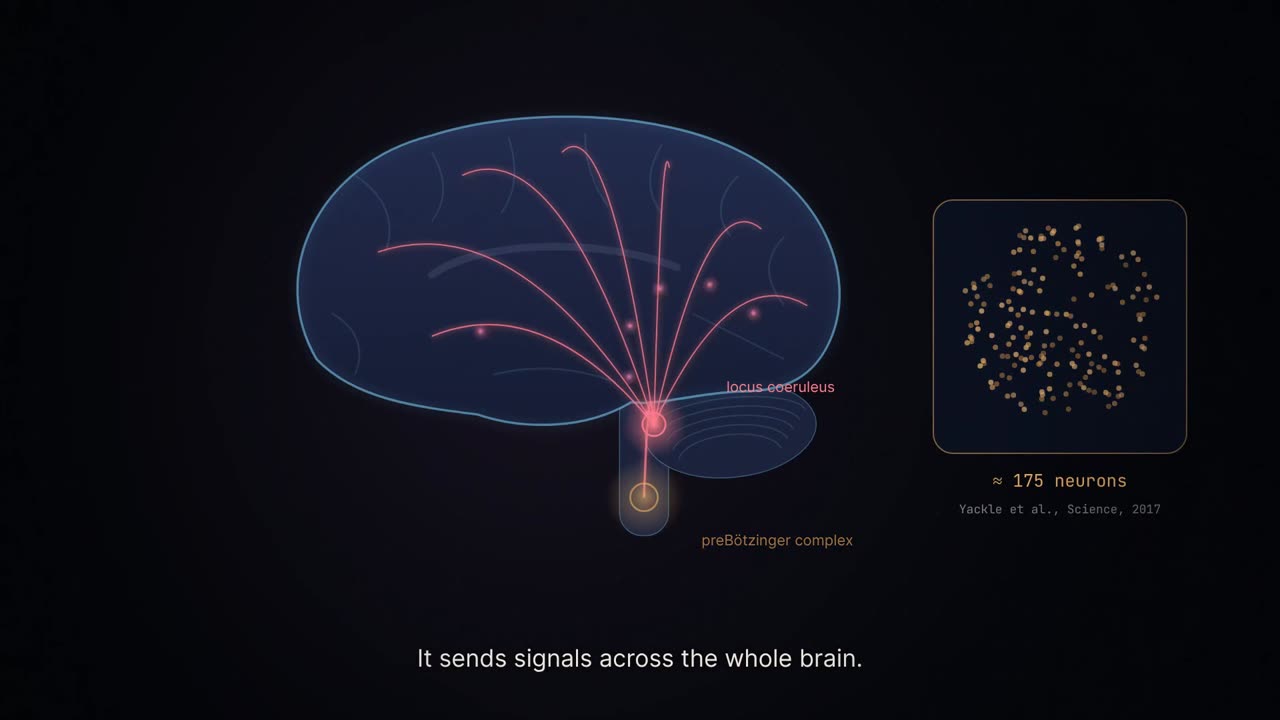
- About 175 brainstem neurons report on breathing to an arousal hub; mice without them breathed slowly and were unusually calm (a mouse study)
- Amygdala and hippocampus activity rises and falls with breathing through the nose
- Fearful faces were spotted faster, and objects remembered better, on the in-breath; the effect faded with mouth breathing
- In a month-long study, 5 minutes a day of exhale-focused "cyclic sighing" improved mood more than mindfulness meditation
Three cyclic sighs: breathe in through the nose, take one more short sip of air, then a long, slow exhale through the mouth.
Read the transcript
Thousands of times a day, you breathe without thinking about it.
Breathing is automatic.
But it’s the one automatic rhythm you can also take over, any time you choose.
You can’t steer your heartbeat or your stress hormones directly.
Your breath, you can. And it talks back to your brain.
Deep in the brainstem, a small cluster of cells keeps the rhythm.
In 2017, Stanford scientists found about 175 neurons there that report on breathing to the locus coeruleus, an arousal hub.
It sends signals across the whole brain.
When those neurons were removed, mice breathed more slowly and became unusually calm.
That was in mice, but humans have the same breathing pacemaker.
Breathing in changes what your brain notices.
In 2016, researchers recorded inside the brains of 7 people who had electrodes placed for epilepsy surgery.
With each in-breath through the nose, activity in the amygdala and hippocampus rose and fell.
In about 60 more people, fearful faces were spotted faster during an in-breath, and objects were remembered better.
Through the mouth, the effect faded.
Breathing out does something else: it slows your heart a little, every time.
A brake you carry everywhere.
In 2023, Stanford researchers had people practise for 5 minutes a day, for a month.
They compared three breathing techniques with mindfulness meditation.
The biggest mood boost came from an exhale-focused breath called the cyclic sigh.
It also lowered resting breathing rate more than meditation did.
Try it with me.
Breathe in through your nose
One more short sip of air
Long, slow exhale through your mouth
Breathe in through your nose
One more short sip of air
Long, slow exhale through your mouth
Breathe in through your nose
One more short sip of air
Long, slow exhale through your mouth
Breathing in sharpens what you notice.
Breathing out slows you down.
Your breath is the one door into your nervous system that you can open on purpose.
- Yackle et al. (2017), Science; Stanford Medicine summary
- Zelano et al. (2016), Journal of Neuroscience; Northwestern summary
- Balban et al. (2023), "Brief structured respiration practices enhance mood and reduce physiological arousal", Cell Reports Medicine
Every number in the film is checked against these sources. Diagrams are simplified, and charts marked "schematic" show the shape of a finding, not its exact values.