
The Quiet Mind Lesson 3 of 6 · The wandering mind
The Network That Never Rests
What your brain does when you are doing nothing: the default mode network, how it was discovered, and what four studies show meditation does to it.
Unlock all the films with your email
You get all six films in The Quiet Mind, plus evidence-checked articles on meditation and breathing by email. No payment. Unsubscribe any time.
Your email is kept by Kit, the service that sends our newsletter. See the privacy page.
You're in. Check your inbox and click Kit's confirmation link, so the articles reach you too.
- The brain is about 2% of body weight but uses about 20% of its energy, and tasks barely change that
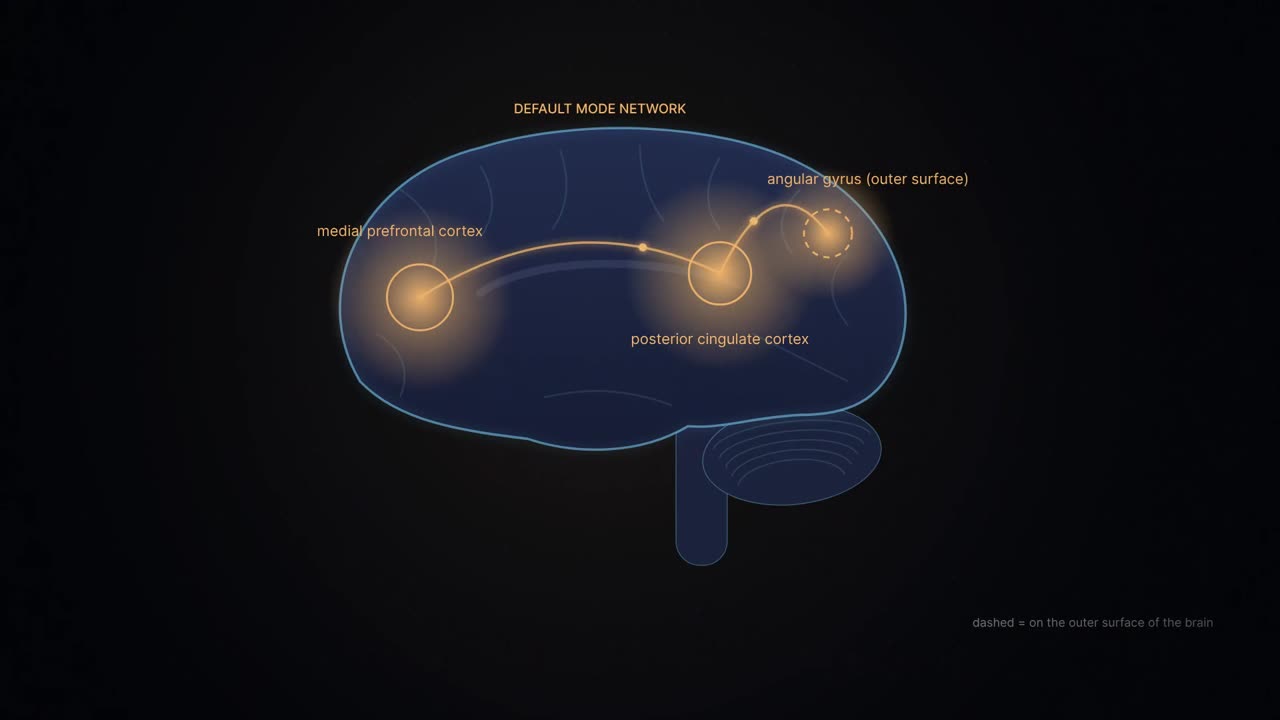
- The default mode network: regions more active at rest, with hubs in the medial prefrontal and posterior cingulate cortex
- In 14 meditators, each catch of a wandering mind moved through four phases: wandering, noticing, shifting, staying
- In 12 experienced meditators (about 10,565 hours on average), default mode hubs were quieter than in 12 beginners
- That comparison is a correlation, not proof that meditation caused the difference
Sit for five minutes with your attention on the breath. Each time you notice your mind has wandered, count one "rep" and come back.
Read the transcript
What is your brain doing when you’re doing nothing?
Your brain is about 2% of your body’s weight, but uses about 20% of its energy.
And starting a task barely changes that.
Brain scanners in the 1990s showed something strange.
When people stopped a task and rested, some regions became more active, not less.
In 2001, Marcus Raichle called it the brain’s “default mode”.
Its main hubs sit along the midline: medial prefrontal and posterior cingulate cortex.
It’s the network behind your inner monologue: memories, plans, and thoughts about yourself and others.
It’s how you plan a life and understand people.
But it runs a lot. In one Harvard study, minds wandered in 46.9% of moments.
And wandering minds were less happy.
So what happens when you try to sit with your breath?
In 2012, Wendy Hasenkamp scanned 14 meditators focusing on the breath.
Each time they caught their mind wandering, they pressed a button.
Around each press, the brain moved through four phases.
Wandering. Noticing. Shifting. Staying.
Every catch is one repetition. Like a curl at the gym, for attention.
In 2011, Judson Brewer’s team compared 12 experienced meditators with 12 beginners.
The meditators averaged over 10,000 hours of practice.
Across three styles of meditation, their default mode hubs were quieter.
And those hubs were more tightly linked to regions for self-monitoring and control, even at rest.
One caution: this compared two groups of people.
It can’t prove meditation caused the difference.
Meditation doesn’t switch off the default mode.
It may change your relationship with it: noticing sooner, and coming back.
Your mind will wander. That’s the default. Coming back is the practice.
- Raichle et al. (2001), "A default mode of brain function", PNAS; background from the US National Science Foundation
- Killingsworth & Gilbert (2010), "A Wandering Mind Is an Unhappy Mind", Science
- Hasenkamp et al. (2012), "Mind wandering and attention during focused meditation", NeuroImage
- Brewer et al. (2011), "Meditation experience is associated with differences in default mode network activity and connectivity", PNAS
- Yale News: "Tuning out: How brains benefit from meditation"
Every number in the film is checked against these sources. Diagrams are simplified, and charts marked "schematic" show the shape of a finding, not its exact values.