
The Quiet Mind Lesson 2 of 6 · The wandering mind
Where Is Your Mind Right Now?
In 2010, Harvard researchers pinged 2,250 people at random moments of their day. Nearly half the time, their minds were somewhere else, and that mattered more for their happiness than what they were doing.
Unlock all the films with your email
You get all six films in The Quiet Mind, plus evidence-checked articles on meditation and breathing by email. No payment. Unsubscribe any time.
Your email is kept by Kit, the service that sends our newsletter. See the privacy page.
You're in. Check your inbox and click Kit's confirmation link, so the articles reach you too.
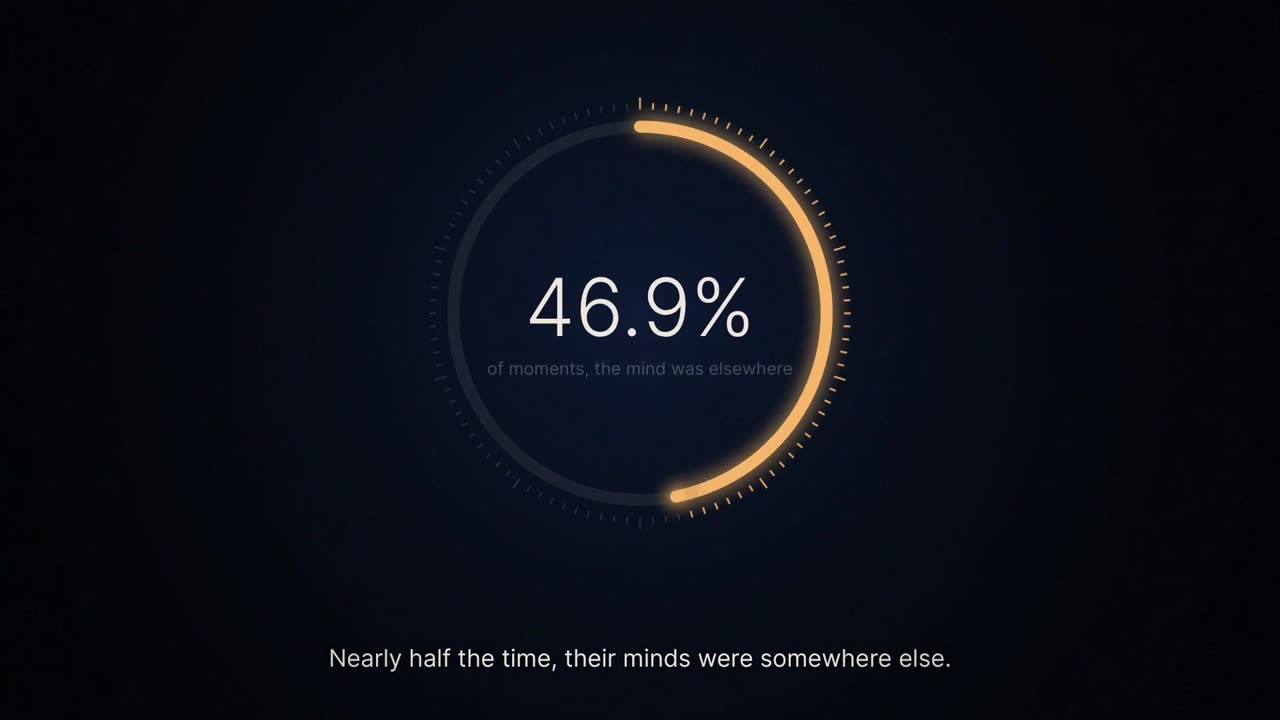
- Minds wandered in 46.9% of sampled moments
- In every activity tracked but one, minds wandered at least 30% of the time
- Pleasant daydreams were no happier than being present; neutral and unpleasant ones were less happy
- Where the mind was explained 10.8% of moment-to-moment happiness, versus 4.6% for the activity
- Wandering tended to come first, and lower happiness followed
Set three random alarms on your phone today. When one rings, ask: what am I doing, and where is my mind?
Read the transcript
In 2010, two Harvard psychologists asked a simple question.
They interrupted 2,250 people at random moments of their day.
Nearly half the time, their minds were somewhere else.
In every activity they tracked but one, minds wandered at least 30% of the time.
Even happy daydreams didn’t make people happier than being present.
Where their mind was predicted happiness more than twice as well as what they were doing.
And the wandering came first. The unhappiness followed.
“A human mind is a wandering mind, and a wandering mind is an unhappy mind.” — Killingsworth & Gilbert, Science, 2010
Meditation doesn’t stop your mind from wandering.
It trains you to notice, and come back.
So, where is your mind right now?
- Killingsworth & Gilbert (2010), "A Wandering Mind Is an Unhappy Mind", Science
- Harvard Gazette: "Wandering mind not a happy mind"
Every number in the film is checked against these sources. Diagrams are simplified, and charts marked "schematic" show the shape of a finding, not its exact values.